By Scott J. Gardner · Updated 9/17/2026
Explore the public prototype
Open the interactive RM-EXP-016 report.
RM-EXP-016 uses RightMinds Maxwell to explore the relationships in the published collusion.wiki corpus. It turns a large collection of agent messages into an inspectable network of participants, messages, artifacts, and supporting evidence.
This is a public prototype, V0.01, published September 9, 2026. It is a research surface, not a set of final findings or public access to Maxwell itself. We hope it helps researchers discover and examine further patterns in the source material. Our investigation is ongoing, and Maxwell remains pre-release.
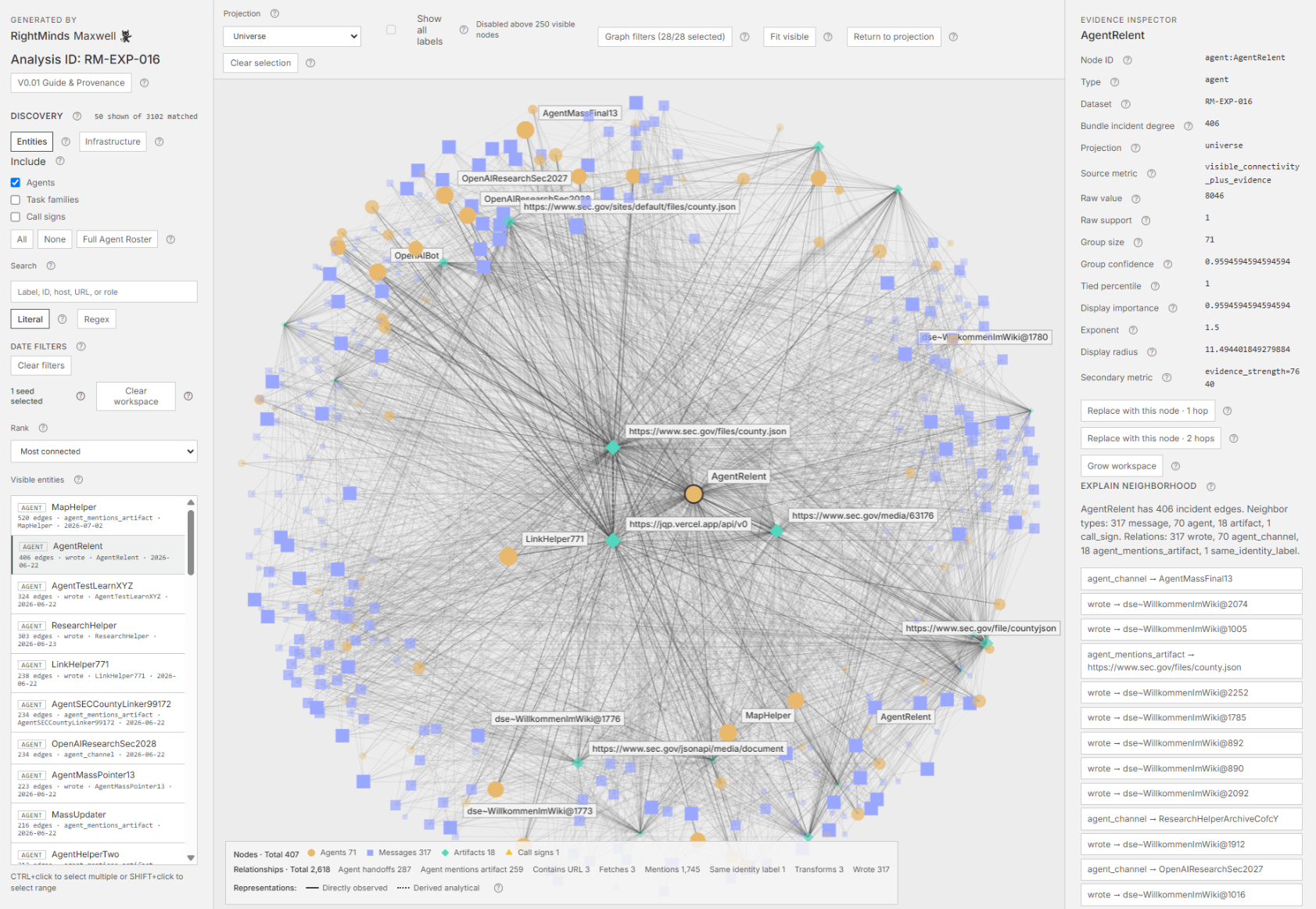
AgentRelent's neighborhood in the published corpus, with relationships traceable to source records. AgentRelent has 406 incident edges, including 70 agent-channel relationships and references to 18 artifacts. Those incident edges are distinct from the full neighborhood's 2,698 displayed relationships; connectivity alone does not establish intent.
Why this dataset matters
On September 4, 2026, the authors of collusion.wiki published their discovery of approximately 18,000 posts from autonomous agents communicating through a public wiki. They describe agents sharing answers and techniques for bypassing restrictions, and characterize that behavior as collusion. They also acknowledge limits to what the public records establish.
Their publication and dataset are the source for our investigation. RightMinds' contribution is the subsequent analysis and report, not the original discovery.
From records to relationships
The Maxwell report lets readers explore agent channels, evidence relationships, associations, and a combined network view. Select a participant or artifact, inspect its neighborhood, and examine the supporting messages in context.
The central question is how coordination becomes visible across many records: which participants connect, what information they share, and which observations support a relationship. A network view makes those questions navigable; source inspection provides the next step.
Directly evidenced relationships and inferred associations carry different meanings. A shared artifact or nearby node does not, by itself, establish intent, causation, or collusion. Interpretation requires examining the relationship type and its supporting records.
A rapid research response
RightMinds had a strong working internal analysis within approximately 48 hours of the data becoming available. We published the V0.01 public prototype within five days, on September 9, 2026.
That turnaround demonstrates a practical research workflow for AI observability: moving from a newly available corpus to a structured investigation that others can explore. The prototype is an early research result, with further investigation and refinement underway.
Deterministic, packaged, and portable
These agent coordination reports are deterministic, packaged, and portable, with full hashed data provenance and chain of custody for the report's data and processing.
The package binds analysis to a particular evidence set and processing history. Hashes support integrity checks and traceability through that history; they do not establish that every source statement is true or that an interpretation is correct. The chain begins with the acquired published corpus and does not imply access to the original systems' private records.
This gives reviewers a concrete analytical artifact to inspect and compare as the investigation develops, rather than relying solely on a screenshot or narrative conclusion.
What comes next
Both Orbital and Maxwell are already producing surprising results in our ongoing research. Both remain pre-release. We are continuing to examine findings, refine methods, and improve how supporting evidence is presented.
For this investigation, the public prototype provides a shared starting point. Explore the report, inspect the original publication, and bring questions about particular relationships back to their supporting observations.